
With many users at each of our farm/field facilities, it is critical to ensure that we have knowledge of all ongoing and desired activities in order to ensure compatibility, and to coordinate resources required to provide support and facilitation as needed. Importantly, we have responsibility for compliance with federal, state, university and local regulations, and to ensure safety for our staff, students, faculty, and visitors.
To request the use of the Organic Research Dairy Farm, please complete the Organic Dairy Facilities Use Request form.
In the form, you will be asked to provide information about the proposed project well in advance, so that we can evaluate our abilities to accommodate your requested use of facilities and resources. The pertinent required information (which is encouraged to be collected and organized in advance) includes the desired use of the facility or facilities, amount of number of cattle, dairy facility space, or other needs for the activity; approximate timeline of the proposed project; required treatments, preparation, applications or modifications to the dairy space, and intended measurements or sampling; the types of staff support that will required; and a completed copy of a IACUC approval form.
The completed form will be submitted to the farm manager, Jason Scruton, and the NHAES director, Anton Bekkerman, for review and approval based on availability resources, potential impacts on existing and planned activities, budgetary ramifications, and related management considerations.
The NHAES Directors office will notify the requestor of a decision along with any qualifications, stipulations and/or requirements. You may be asked to visit with the Facility Manager(s) and/or the NHAES Director’s Office to clarify intended activities and requirements so that we may better serve your needs.
Lastly, please be aware that full adherence to all relevant regulations, institutional approvals and compliance requirements (for example, http://www.unh.edu/research/compliance-safety) is the responsibility of the individual facility user. Supporting documentation must be provided before any use is permitted.
For questions, please contact Ryan Courtright, 603-659-2121.
The Organic Dairy Research Farm is operated by the NH Agricultural Experiment Station and College of Life Sciences and Agriculture, and represents the first of its kind at a land-grant university. It is intended to help the University of New Hampshire explore opportunities for regional dairy producers, forestry managers, and land and water conservation organizations through research.
The farm is home to about 100 registered Jersey cows, heifers, and calves, and located in Lee, about seven miles from the university’s main campus in Durham. The property consists of 275 acres, of which roughly 120 are woodlands, 100 are crops or forage production, and 55 are pastures. In addition to the working land base, the current operation includes a milking Jersey herd twice a day, step-up four-stall milking parlor, animal, equipment and storage barns, intensive rotational grazing system, numerous wells for water sampling, manure composting wind rows, staff offices, and sample processing space. Cows produce an average of 43 pounds of milk a day with 5.1 percent butterfat and 3.6 percent protein.
The farm is managed as an integrated agro-ecosystem that includes the biological, physical and human-related components. As such it offers a platform for research and education across many disciplines. Research priorities are relevant to both organic and conventional farm operations. A primary focus of the farm is to undertake research of relevance to organic farm systems to better serve the organic farming community, consumers, and the environment. Areas of study include dairy nutrition and feeds, pasture quality, forage production, compost production, and management of the associated streams, soils, woodlands, and other natural resources. Faculty scientists and farm staff work cooperatively to undertake these activities while complying with organic certification practices. The farm is a popular destination for visitors and local K-12 school field trips.
Learn about the scientists and latest research at the Organic Dairy Research Farm below.
216 Lee Hook Rd
Lee, NH 03861
United States
CONDUCT RESEARCH AT THE FACILITY
With many users at our organic dairy research farm, it is critical to ensure that we have knowledge of all ongoing and planned activities in order to ensure compatibility and to coordinate resources required to provide support and facilitation as needed. Importantly, we have responsibility for compliance with federal, state, university and local regulations, and to ensure safety for our staff, students, faculty and visitors.
To request the use of the Organic Dairy Research Farm, please complete the ODRF use request form.
In the form, you will be asked to provide information about the proposed project well in advance, so that we can evaluate our abilities to accommodate your requested use of facilities and resources. For questions, please contact the Macfarlane Greenhouse manager, Jason Scruton by email or phone, 603-659-2121.

Precision Dairy Management
Dr. Claira Seely is a dairy scientist whose research is focused on integrating dairy cow biology with precision dairy technologies, especially their adoption on small and medium-sized farms. With a specific emphasis on epidemiological methods, her research goals are to expand the knowledge of transition cow physiology while optimizing and validating technologies that can improve cow health, well-being, and productivity.
Recently at the dairy research farm: Dr. Seely is using devices such as ear tags, collar tags and bolus pills—nondigestible pills that remain in the rumen of the cows—to monitor cow health indicators like rumination patterns, activity levels, and gut health. She is also studying whether non-invasive pulsed electromagnetic field therapy can be used to safely and effectively use electromagnetic pulses to enhance blood flow and reduce inflammation in dairy cows suffering from mastitis. The data from these projects will be used to develop management strategies for farmers.

A More Productive Dairy Sector
Dr. Andre Brito is a dairy scientist who is focused on helping dairy cows use their feed more efficiently by improving their diets, adjusting when forages are harvested, and adding energy supplements to pastures. The overall goal is to support healthier digestion and milk production while cutting down on nitrogen waste that can harm the environment.
Recently at the dairy research farm: Dr. Brito has numerous ongoing projects at the Organic Dairy Research Farm. One focus is assessing whether integrating essential oils into the diets of grazing dairy cows can decrease methane emissions while improving milk production and composition. Additionally, Dr. Brito is investigating the use of the red seaweed to mitigate enteric methane emissions and/or act as a source of minerals to improve animal health. He is also co-leading (with Dr. Pete Erickson) work to evaluate how forage quality (low- or high-quality legume-grass hay) and milk feeding duration (90 vs. 180 days) impacts calf growth and ruminal development.

Better Cow Health, Starting on Day 1
Dr. Peter Erickson’s research focuses on improving the health and growth of dairy cows, especially young calves, by studying their nutrition and how different feeds affect their development. He also looks for new, cost-effective feed ingredients and better ways to manage newborn calves' colostrum—their first, immunity-building milk.
Recently at the dairy research farm: Dr. Erickson's recent research has spanned different areas of dairy health. He is evaluating prolactin and estradiol—key to reproduction and lactation—in cows that are calving and collecting, weighing and assessing their colostrum. He is also co-leading (with Dr. Andre Brito) work to evaluate how forage quality (low- or high-quality legume-grass hay) and milk feeding duration (90 vs. 180 days) impacts calf growth and ruminal development.
Agroforestry in New England
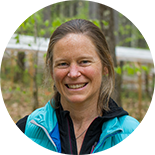
Dr. Heidi Asbjornsen is an ecosystem ecologist who draws on diverse disciplines (plant physiology, ecohydrology, forestry) to understand how different ecosystems are responding to environmental change and then applies this knowledge to develop sustainable management practices. She leads UNH research for improving the design and implementation of diverse agroforestry systems in New England and promoting adoption of agroforestry practices.
Recently at the dairy research farm: Dr. Asbjornen leads the development of two silvopasture experiments: the addition of trees to open pasture and the subtraction of trees from a forest. Pasture conversion (addition) investigates using different tree species, such as chestnut, walnut, and pear varieties. Forest conversion (subtraction) investigates the effectiveness of different management practices, such as slash removal, liming, and forage mixtures, in successful silvopasture establishment.
Click this link to learn more about Dr. Asbjornsen's research

Soil Quality at Pasture-Based Dairies
Dr. Alix Contosta is an ecosystem ecologist who environmental and land-use changes impact soil, forest, and agricultural ecosystems — especially carbon storage, greenhouse-gas fluxes, and winter-to-spring dynamics. She uses field experiments, environmental sensors, and long-term monitoring to track how weather patterns and land-use shape ecosystem resilience and carbon and nutrient cycling.
Recently at the dairy research farm: Dr. Contosta has a long history of work at the dairy—collecting soil samples from over 170 sites during the dairy's organic transition and a decade later, to study the impacts of grazing management on soil organic matter and building of carbon in soil. Her more recent work continues this line of research, focusing the cow grazing activities on soil after the animals consume feed additives—such as seaweed—that are intended to reduce methane emissions.
Click this link to learn more about Dr. Contosta's research

Microbiomes in Water and Soil
Dr. Anna O'Brien's research considers how microbes living on and around plants influence a plant’s ability to cope with environmental changes like weather pattern shifts and pollution—and how those same environmental pressures can, in turn, reshape plant–microbe interactions. Using genetic, evolutionary, and experimental tools, Dr. O'Brien's work can help improve agriculture and protect ecosystems in parallel.
Recently at the dairy research farm: Dr. O'Brien's work at the research dairy examines microbial communities in ponds near and around animal pasture areas. One of her projects examines populations of microbes and duckweed—an aquatic plant that can quickly uptake excess nitrogen—to understand the symbiotic relationship of the plants and microbes near agricultural sites. She is also investigating water samples if cyanobacteria blooms are observed in ponds across the research farm, studying how microbial populations and opportunistic algae interact.

Improving Dairy Cow Reproductive Health
Dr. Paul Tsang's work examines how hormones, enzymes, and signaling proteins shape ovarian activity and fertility in mammals, and how dairy cows' ovaries build its blood vessel network—and how the protein CCN1 helps regulate progesterone production. A better understanding of these biological processes can improve dairy producers' ability to their animals' health and improve fertility in livestock.
Recently at the dairy research farm: Dr. Tsang's current research focuses on how specific signaling molecules—especially angiotensin proteins from the ovary’s local renin–angiotensin system—affect key ovarian cells that support hormone production and healthy pregnancies. By uncovering how these signals regulate important factors like RhoA and CCN1, the work is seeking to understand why some cattle fail to become or stay pregnant and how the ovary, uterus, and early embryo respond to both internal hormones and external stressors.

Assessing Water Quality
Dr. Adam Wymore studies how water, nutrients, and pollutants move through watersheds, from land (including farms and developed areas) into rivers and streams, and how those flows affect water quality and ecosystem health. The research connects environmental science to practical agriculture and policy, showing how what happens on farms and in towns can ripple through water systems.
Recently at the dairy research farm: As the leader of the NH Water Resources Research Center (WRRC), Dr. Wymore and his team collect samples from surface and groundwater at the farm, given its unique location abutting a river and having numerous agricultural and forestry activities on site. The WRRC has more than a decade of data from stream sensors and water samples that measure nitrate, temperature, pH, conductivity, nitrogen, carbon, phosphorous, dissolved organic matter, among other characteristics. Dr. Wymore (with Dr. Paula Mouser) is also studying PFAS deposition in rain–soil–watershed systems.
Click this link to learn more about Dr. Wymore's water quality research

Assessing PFAS Impacts
Dr. Paula Mouser research examines how contaminants such as persistent pollutants like PFAS move through water, soil, and wastewater systems and how microbial and chemical processes affect their breakdown or persistence. Dr. Mouser applies environmental microbiology and bioprocess science to understand how microbial communities influence contaminant fate in natural and engineered systems, helping guide wastewater treatment, water quality protection, and the prevention of chemical exposure in ecosystems.
Recently at the dairy research farm: The farm serves as one of Dr. Mouser's sites for collecting samples of rain, farm soils, and a local watersheds to track how dozens of PFAS types through the deposition system—rain–soil–watershed. The research (with Dr. Adam Wymore) seeks to understand how different uses of land—agricultural, forested, residential, commercial—may affect the deposition flow.
