
From our research plots,
to farms and gardens near and far.
UNH has a long history of developing new horticultural and ornamental plant varieties for food and beautifying homes and landscapes. The plant research inspired and supported by the NH Agricultural Experiment Station is innovation in action.
Plant breeding was a longstanding and central activity of the New Hampshire Agricultural Experiment Station—beginning as early as 1887— with sustained efforts focused on developing hardy, high‑quality, and disease‑resistant plants adapted to the state’s short growing seasons and cold winters. Early work in horticulture and agronomy emphasized variety testing and selection.
In 1902, research by faculty in the Horticulture and Forestry departments was conducted across greenhouses, orchards, and grounds. The orchards and vineyards consisted of grapes, cherries, peaches, and apples. Vegetables were grown alongside the orchards. Research focused on methods of growing, fertilizing tactics, variety trials, and propagation techniques.
Breeding at the NH Agricultural Experiment Station continued throughout the Great Depression and two World Wars. Researchers developed and used new technology to collect and analyze more precise data, have better propagation methods, and release new varieties that had better resistance to pathogens and diseases.
By the mid‑20th century, the Station had established a nationally recognized breeding program encompassing fruits, vegetables, ornamentals, and forage crops. The most intensive period of plant breeding began under A. F. Yeager and expanded significantly through the work of Elwyn W. Meader, who served as a Station plant breeder for 18 years. Meader alone contributed to nearly half of the roughly 100 plant varieties introduced between 1939 and the mid‑1970s, assembling germplasm from around the world and adapting it to New England conditions. Breeding objectives consistently emphasized early maturity, winter hardiness, yield, and resistance to diseases and insects.
Major breeding achievements included tomatoes resistant to late blight, cold‑hardy peaches, improved raspberries, strawberries, blueberries, and a wide range of vegetables such as peppers, beans, squash, eggplant, melons, and beets. Notable examples documented in the booklet include the ‘Doublerich’ tomato (enhanced vitamin C), ‘Golden Midget’ watermelon (color‑based ripeness indicator), ‘Sweetheart’ beet (high sugar content), and the ‘Meader’ blueberry. Breeding also extended to forage and field crops, including work on resistance and adaptability in corn, bromegrass, clovers, and legumes.
In addition to food crops, the Station developed numerous ornamental plants, including lilacs, chrysanthemums, roses, Monarda (bee balm), azaleas, and rhododendrons, many selected for cold tolerance, disease resistance, and extended flowering periods. By 1987, the Station had formally released 111 horticultural plant varieties, reflecting a century‑long commitment to plant breeding tailored to northern climates.

Innovating Tomorrow’s Squash and Pumpkins
Led by Chris Hernandez, UNH’s cucurbit breeding program—North America’s longest continuously running pumpkin and squash breeding initiative—is advancing genomic tools and contemporary breeding methods to create new varieties with improved yield, disease resistance and nutritional content. The program has led to over 100 new variety releases, 50 exclusive licenses held by UNH and more than $2 million in royalties that continue to move this UNH research program.
Recent research: Dr. Hernandez, graduate students, and research assistant Renee Goyette are working to develop new varieties of these staple New England crops with improved characteristics like increased market yield, disease resistance and nutritional quality. With an eye on global agriculture, Hernandez plans to release breeding lines through commercial seed producers to farmers inNew Hampshire and around the world.
Click this link to learn more about Dr. Hernandez's cucurbit breeding program

Bringing Underutilized Crops to New Hampshire
Iago Hale is always on the lookout for the hidden gems of the agricultural world. Hale is interested in the characterization, maintenance, and utilization of crop genetic diversity as means of enhancing small farm viability, rural livelihoods, food security, and ecosystem integrity. For Hale, crop improvement is fundamentally about increasing the options available to both growers and consumers within a context of dynamic market forces, increasing land-use pressures, and uncertain environmental factors.
Recent research: Dr. Hale leads the Kiwiberry Research and Breeding Program at UNH, founded in 2013 to develop elite varieties and best management practices to increase commercial potential of this under-utilized grape-sized, tropical-tasting fruit that is a delicious, nutrient-dense crop. Many of the over 2,000 breeding lines begin at the Macfarlane Research Greenhouses. A newer endeavor is In a recently begun Tartary buckwheat breeding program, which is assessing whether this promising underutilized crop would be a good fit for the northeast. Fast growing and highly drought tolerant, even in depleted soils, this gluten-free pseudo-grain boasts a rich flavor and impressive nutritional profile.
Click this link to learn more about Dr. Hale's breeding program

Improving New Hampshire's Strawberries
Lise Mahoney is a plant geneticist who has been advancing the release of locally bred strawberries. Her goal is to be able to produce plants that can be used for ornamental purposes and organic production in cool climates. Dr. Mahoney has focused on breeding strawberries that produce not only on delicious fruit, but also rich foliage and flowers ranging from red to yellow and everything in between.
Recent research: Dr. Mahoney continues to cross multiple promising lines of organic strawberries in the Macfarlane Research Greenhouses, which will then be transplanted for further assessment to the Woodman Horticultural Research Farm in the spring.

From Native Plants to New Crops
Tom Davis is a plant geneticist who is interested in understanding how to utilized an untapped natural resource in northern New England region: its wild and weedy plant species. But can locally adapted, endemic species be rapidly domesticated into plants suitable for cultivation (a process known as de novo domestication)? Davis's research is evaluating candidate native food crops and weeds and genetically defining traits for effective cultivation.
Recent research: Dr. Davis is working with graduate student Mamta Kajal to domesticate new commercial strawberry varieties using wild strawberries from around the world. Additionally, Davis and research scientist Clay Ludwig and collaborating to interbreed quinoa—native to Peru and unsuitable in existing varieties to grow in a humid and cool New England climate—with weeds of the same genus as quinoa but that grow readily in New England. Ultimately, their goal is to develop quinoa hybrids that can grow in New England's specific climates.
Click this link to learn more about Dr. Davis's plant genetics research program
If you've visited our research showcase events or talked to Station researchers or staff around the staff and region, you may have come home with a plant or seeds that were developed as part of NH Agricultural Experiment Station research programs. While these represent a tiny fraction of what Station scientists have developed over the last century, we hope you are as excited as we are to know about the plants history and some care tips.

'Wildcat Blue' and 'Wildcat Mandarin'
Anagallis monelli
Developed in the early 2000s by UNH research assistant professor Rosanna Freyre, the two varieties were primarily developed at the UNH Macfarlane Research Greenhouses. The varieties were licensed and are now sold in the Proven Winners catalogue of New Hampshire-based Pleasant View Gardens. These plants are a flaxleaf pimpernel, a perennial herb native to the Mediterranean region, and are heat-tolerant and require little maintenance. No deadheading is required to keep these plants blooming all summer long.
Plant Type:
Annual
Light Requirements:
Full sun
Water Requirements:
Moist, well-draining soil
When to plant:
When outdoor temperatures stay above 60F at night.

Orange Smoothie Pumpkin
Cucurbita pepo
Developed at UNH by J. Brent Loy in the late 1990s and released in 2002, this pumpkin variety yields a smaller 5–9 pound fruit with a smooth skin and vivid color. The pumpkin variety was developed as part of the UNH Cucurbits Breeding program, which has been in continuous operations for over 70 years. The pumpkin won the 2002 All-American Selection recognition for superior garden and plot performance.
Plant Type:
Annual
Light Requirements:
Full sun
Water Requirements:
Deep water, approximately 1–1.5 inches per week. More under drought conditions.
When to plant:
Sow directly outdoors after last frost (late-May or early June, or when the soil temperatures is at least 70F) into soil approximately 1–1.5 inches deep. Alternatively, start indoors in early to mid-May and move outdoors after the last frost and night temperatures are above 50F. Ensure 1 inch spacing between plants.
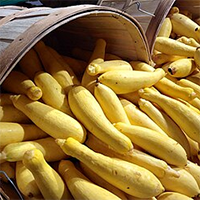
Slick Pik Summer Squash
Cucurbita pepo
Developed at UNH by J. Brent Loy in the early 2000s and released in 2009, the Slick Pik is a hybrid summer squash variety that has high production potential and a smooth-skinned, 8-inch straight fruit that's great for fresh market and gardens. The variety has good flavor, earlier harvests, and a bushy growth pattern, which reduces disease pressure. The squash variety was developed as part of the UNH Cucurbits Breeding program, which has been in continuous operations for over 70 years.
Plant Type:
Annual
Light Requirements:
Full sun
Water Requirements:
Deep water, approximately 1–1.5 inches per week. More under drought conditions. Plants that are allowed to dry out during flowering and fruit setting will have reduced yields.
When to plant:
Direct sow outdoors is recommended after last frost (late-May or early June, or when the soil temperatures is at least 60–65F) into soil approximately 0.5–1.0 inches deep, with shallower planting later in the spring for faster emergence.
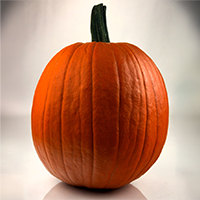
Renegade PMR Pumpkin
Cucurbita pepo
The 15-pound perfect Jack-O-Lantern pumpkin! A hybrid variety that was developed in the early 2010s and released commercially in 2019, this uniform, deep colored, strong-handled pumpkin is ideal for growing commercially for sale or in backyard gardens. The variety provides intermediate resistance to powdery mildew, has high marketable yields, and is great for carving at Halloween or decorating in late Fall. The pumpkin variety was developed by J. Brent Loy as part of the UNH Cucurbits Breeding program, which has been in continuous operations for over 70 years.
Plant Type:
Annual
Light Requirements:
Full sun
Water Requirements:
Deep water, approximately 1–1.5 inches per week. More under drought conditions. Avoid prolonged wetness to limit diseases.
When to plant:
Sow directly outdoors after last frost (late-May or early June, or when the soil temperatures are 60–70F) into soil approximately 1–1.5 inches deep. Alternatively, start indoors in early to mid-May and move outdoors after the last frost and night temperatures are above 50F. Ensure 1 inch spacing between plants.
